Semi-permanent makeup
Ombré & Powder Brows in Bracknell
A soft, misty brow that looks like beautifully applied powder — fuller where you want fullness, light and natural at the front, and there every morning without a pencil. £210, personally by Safina.
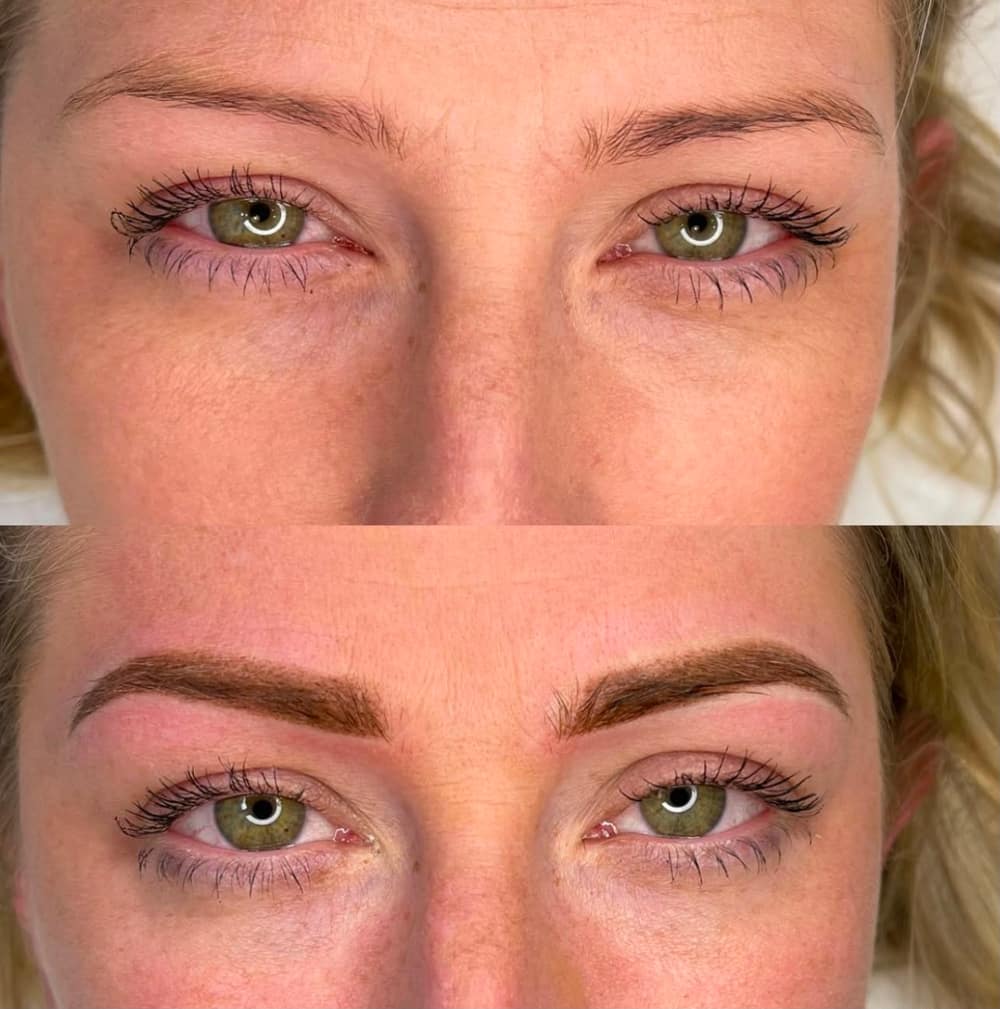
If you fill your brows in every single morning — and quietly panic about the gym, the pool or the first holiday photo of the day — this is the treatment that gives you those mornings back. Ombré and powder brows are semi-permanent makeup: soft, shaded colour worked into the upper layers of the skin so your brows look finished from the moment you wake up.
The pigment is applied with a machine that stipples thousands of tiny points of colour into the skin, building depth gradually rather than cutting lines into it. The healed effect is a brow that reads like powder or a light pencil, not a tattoo — which is exactly the point. Safina has been in the beauty industry for sixteen years, and brows are where she started.
Ombré or powder — what’s the difference?
They are the same technique with a different finish, and clients often use the two names interchangeably. The distinction is simply where the colour sits.
Ombré browsare graded. The front of the brow is kept deliberately light and diffused so it melts into your skin, then the colour builds through the arch and deepens towards the tail. It’s the softest option at the inner corner, which is what makes it read as natural — a made-up brow is rarely dark right at the nose.
Powder browscarry a more consistent wash of colour from front to tail, for a slightly more defined, made-up finish. If you like a fuller, more finished brow in your everyday makeup, this is usually the one you’ll prefer.
Both are £210, both take around two hours, and both include the same design and pigment-matching process. You genuinely do not need to decide before you arrive — Safina will look at your natural brows, your colouring and a photo or two of brows you like, and tell you which of the two will suit you.
What ombré and powder brows can do
- Fill sparse or over-plucked brows — including areas where hair no longer grows.
- Correct asymmetry — even up two brows that have never quite matched.
- Give shape to fine, pale hair — definition that a tint alone can’t reach.
- Survive water and sweat — swimming, the gym, holidays, no touch-ups.
- Save real time — ten minutes back every single morning.
- Hold up on oily skin — shading blurs far less than fine hair strokes.
An honest comparison
Why we shade rather than microblade
Microblading is the technique most people have heard of, and Lady Young’s deliberately doesn’t offer it. It uses a fine blade to cut hair-like strokes into the skin and fill them with pigment. On the right skin, freshly healed, it can look beautiful. The difficulty is what happens over the following year: those crisp individual strokes need the skin to hold a clean line, and skin that is oily or has larger pores tends to spread the pigment slightly, so the strokes soften, merge and can end up looking smudged rather than hair-like.
Shaded brows have no fine lines to lose. Because the colour is built from stippled points rather than cut strokes, it fades as a soft shape rather than a blurred one, which makes the healed result far more predictable across a much wider range of skin types. It is also gentler work on the skin. That reliability is why Safina chose to specialise in ombré and powder brows instead.
If you’d like the full comparison — including how these sit against a non-tattoo option — our guide to brow lamination vs microblading walks through the differences. And if you’re not ready for anything semi-permanent, brow lamination gives fuller, brushed-up brows for six to eight weeks using nothing but your own hair — a genuinely good way to trial a shape before committing to pigment.
In the treatment room
Mapped, approved, then shaded
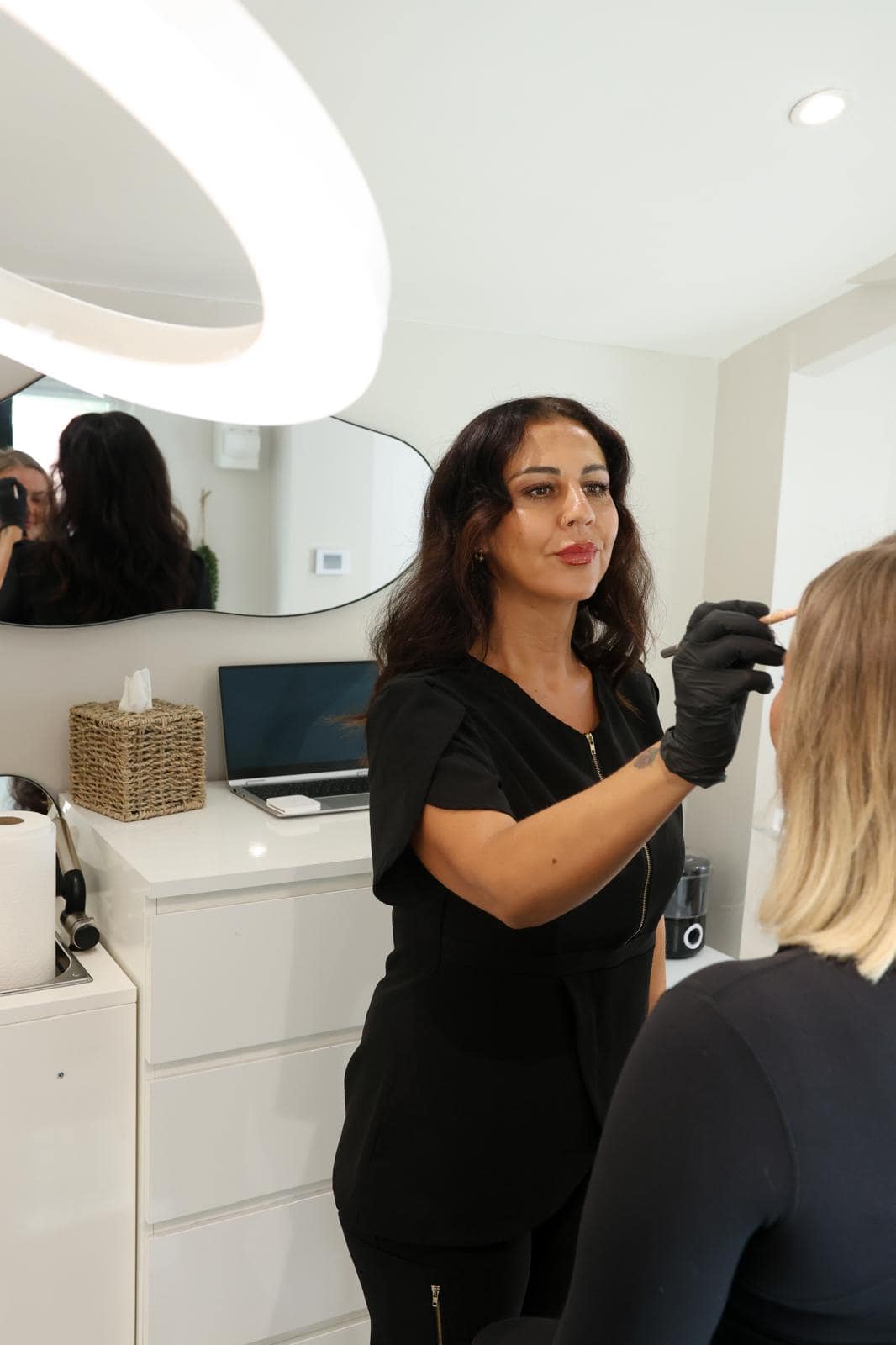
Every brow is measured and drawn on before any pigment goes in, and nothing starts until you’ve seen the shape in the mirror and said yes. Two hours in a private studio, with one practitioner, start to finish.
What to expect
Your ombré brow journey
Consultation & patch test
A short appointment before the day itself: we talk through the shape and depth you want, Safina checks your skin and brow hair, and a patch test is carried out to rule out sensitivity to the pigment.
Mapping & your approval
On the day, your brow shape is measured and drawn on to suit your features and how your brows actually grow. You see it in the mirror and approve it — or change it — before anything begins. Pigment is mixed to your skin tone and hair colour at this stage too.
Numbing & shading
The area is numbed, then Safina builds the shade in gentle passes with the machine, working colour up gradually rather than going in heavy. Around two hours, most of it spent getting the balance and the gradient right.
Healing & your top-up
You'll leave with written aftercare and a clear picture of what the next fortnight looks like. Your top-up is booked for 4–6 weeks later, once everything has healed and we can both see what your skin has kept.
The bit nobody warns you about
How ombré brows heal, week by week
Healed brows and fresh brows look like two different treatments. Knowing the stages in advance is the difference between a calm fortnight and a worried one — particularly the third week, when almost everyone thinks their brows have vanished.
- Days 1–3 — bold. Darker, sharper and more intense than your final result, with some tenderness and perhaps a little swelling. This is surface pigment sitting on healing skin. Keep them dry and follow your aftercare to the letter.
- Days 3–7 — flaking. The top layer begins to lift and flake away, taking the surface colour with it. Do not pick, scratch or help it along; pulling a flake early pulls pigment out with it and leaves a gap.
- Weeks 2–3 — ghosting. The stage that panics everyone. The colour can look faint, patchy or almost gone, because a fresh layer of skin has healed over the pigment and is temporarily veiling it. Nothing has failed. Sit tight.
- Weeks 4–6 — the bloom.Colour resurfaces and settles into its true, softer tone as the skin finishes healing. This is your real result — and the point at which your top-up appointment lands, so any thin areas can be filled and the depth perfected.
Lips heal along much the same path, and our lip blush aftercare & healing guide sets out the day-by-day detail if you’d like to read further. Planning brows around a wedding? Our bridal beauty timeline explains why the first session needs to be at least three months before the day, so the top-up and the bloom are both well behind you.
Pricing
Ombré & powder brow prices
The two treatments are the same price. Below them is the full maintenance ladder, published in full so you can see what the years after your first appointment actually cost — the top-up at 4–6 weeks is part of the treatment, not an upsell, and every colour boost after that is priced by how long it has been since your last session.
Ombré brows2 hr
A gradient effect of light to dark through the brow
£210
Powder brows2 hr
A soft, even powdered finish throughout
£210
PMU brow top-up (4–6 weeks)1 hr 30 min
Your second session — must be booked within 4–6 weeks of the first
£100
Colour boost (6 weeks–3 months)1 hr 40 min
£100
PMU top-up (3–6 months)2 hr
£125
Colour boost (6–12 months)1 hr 40 min
£140
Colour boost (12–18 months)1 hr 40 min
Correcting or refreshing another artist's work may be more — Safina will confirm at your patch test
£165
Prices are correct at the time of publishing and are confirmed at your consultation. Some treatments start from the price shown and vary with the amount of product used or the area treated.
Having your lips done too? Lip blush is priced the same way — see lip blush — and the whole semi-permanent makeup menu sits together on one page, lash-line enhancement included.
Before you book — anywhere
Semi-permanent makeup and the law
Semi-permanent makeup is tattooing, and in England it is regulated as such. Under section 15 of the Local Government (Miscellaneous Provisions) Act 1982, nobody may carry on the business of tattooing or semi-permanent skin-colouring— defined in the Act as “the insertion of semi-permanent colouring into a person’s skin” — unless both the practitioner and the premises are registered with the local authority. Micropigmentation, microblading and PMU all fall inside that definition. It exists for a simple reason: needles in skin carry an infection risk, and registration is how councils check hygiene, sharps handling and sterilisation.
So ask. Ask whoever you book with — here or anywhere — whether they and their premises are registered, what pigments they use, and whether a patch test is included as standard. The NHS suggests the same sort of homework in its guide to choosing who will do your cosmetic procedure: check the qualifications and training, ask how many of these they have done, confirm they are insured, and be wary of anyone offering the treatment in a hotel room or a front room. Cleveland Clinic’s patient guidance on micropigmentation makes the same point, and is also where the honest bit about longevity comes from: the pigment never washes off, but it fades, because your skin cells are continually replaced. That is why every artist prices colour boosts.
At Lady Young’s there is one practitioner and one answer to each of those questions. Safina has sixteen years in the beauty industry, holds a Level 5 Ofqual qualification in aesthetics, is fully insured and works from her own private studio — and a patch test and consultation are arranged before every PMU appointment as standard. You can read more about her training on the about page, see what clients say on the reviews page, or just send her a photo of your brows and ask what she’d suggest.
Your questions
Ombré & powder brow FAQs
You might also like
Related treatments & guides
Lip Blush
Soft, semi-permanent lip colour — the most-booked PMU treatment at the clinic. £210.
Learn moreBrow Lamination
Fuller, brushed-up brows for six to eight weeks with no tattooing. £45.
Learn moreGuide: Lamination vs microblading
Technique, longevity, aftercare and who each one suits.
Read the guideBook your appointment
Ready when you are
Every treatment starts with an honest, no-pressure consultation. Book online in a few taps, or get in touch with any questions.
Call 07500 503034 · Bracknell, Berkshire