Aesthetics · Skin boosters
Polynucleotides in Bracknell
A repair treatment rather than a filler — for thin, crepey, tired-looking skin, and for the delicate under-eye area where most fillers are the wrong answer. £200 for the two-session face course, £130 for under-eye boosters, personally by Safina.
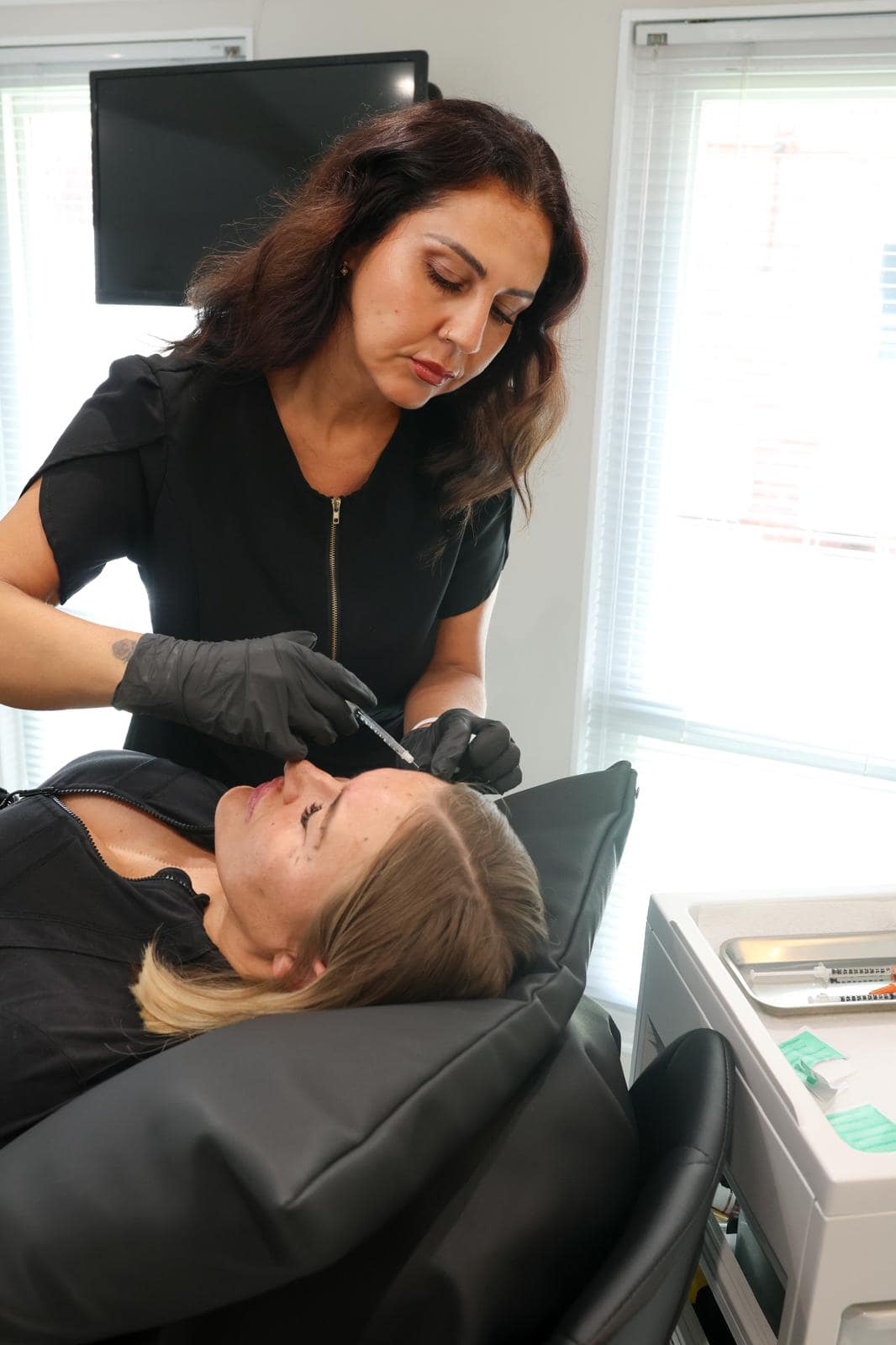
Polynucleotides are the treatment people come in asking about by the wrong name — “the salmon DNA one”, or just “the under-eye injections”. They are an injectable skin booster, and like Profhilo they work on the quality of your skin rather than its shape. Nothing about them will make a flat cheek fuller or a soft jaw sharper.
What makes them worth a page of their own is where they can be used. They are the treatment of choice for skin that is too thin and too delicate for most other injectables — which is why the under-eye version is the one most people have heard of.
What is actually being injected
Consulting Room describes polynucleotides as “highly purified DNA fragments used in aesthetic medicine to support skin repair, regeneration and long-term skin quality improvement”, and notes that products such as Plinest are CE-marked medical devices. The Top Doctors clinical guide, written by consultant dermatologist Dr Ariel Haus, is blunter about the source: they are “injectable, sterile and highly purified products, derived from fish, typically salmon or trout”.
So the “salmon DNA” nickname is fair. The DNA is fragmented and purified to the point where it carries no genetic information — it acts as a biological signal that nudges your own fibroblasts, the cells that build collagen and elastin, back into repair mode. That is the entire mechanism. Nothing is being added to hold a shape.
It also means the product is animal-derived, and that has two practical consequences that no amount of marketing gets round: it is unsuitable if you have a fish allergy, and unsuitable if you avoid animal-derived ingredients.
Polynucleotides or Profhilo — how Safina chooses
Both are injectable skin boosters, both are courses, and both are for skin quality rather than volume. The difference is what is in the syringe and therefore what it does.
- Profhilo is hyaluronic acid. It holds water in the skin, so what you notice is hydration and bounce across the mid and lower face. It goes in at ten set points in a fixed pattern.
- Polynucleotides are purified DNA fragments. They work by prompting repair rather than by holding water, and they are placed shallowly wherever the skin needs them — including areas where a hyaluronic-acid product would be too much.
- The under-eye is the clearest split. Consulting Room specifically lists polynucleotides as suitable for thin and delicate skin including the under-eye area, the neck and the décolletage. That is the area they are best known for.
Our guide to Profhilo vs fillers covers the bigger question underneath all of this — whether your complaint is about the surface of your skin or its shape. If it turns out to be shape, a booster of any kind is the wrong purchase.
What to expect
The course, step by step
Consultation
The first question is whether your complaint is skin quality or shape, because polynucleotides only help with quality. Safina also checks your medical history here — fish allergy, pregnancy and breastfeeding all rule the treatment out, and they need to come up before you book rather than on the day.
Session one
A series of small, shallow injections into the skin of the area being treated. The face, neck or body appointment is 35 minutes; the under-eye booster is 30. You may leave with slight puffiness and the odd pinprick of bruising, both of which usually settle within a couple of days.
Session two, about four weeks later
Polynucleotides are a course, not a single treatment — the £200 face price covers two sessions, and the under-eye booster is normally two to three. The gap lets the first session's repair response get going before the next one builds on it.
Judge it at around three months
This is a slow treatment and the temptation is to write it off after session one. In the 2026 periorbital study the improvement was still climbing at three months, which is the point to look properly and decide whether you want a maintenance session later in the year.
The one everyone asks about
Under-eye polynucleotides
The under-eye booster is £130 and runs to two or three sessions. It is aimed at under-eye skin that has gone thin, crepey and dull — the sort that creases when you smile and looks tired however much you sleep.
It is not a treatment for a hollow. This distinction decides whether the appointment is worth booking, so it is worth being precise: if the darkness under your eye is a shadow cast by lost volume at the orbital rim, the area needs support, and the tear trough filler page explains when that is appropriate and when it is not. If the skin itself is the problem, polynucleotides are aimed at the skin. Plenty of people have a bit of both, and the honest answer at consultation is sometimes to treat one and reassess.
The best evidence specific to this area is a 2026 prospective study in the Journal of Cosmetic Dermatology (Ziade et al.). It followed 42 patients, mean age 43, who had two sessions of polynucleotide injections three weeks apart, with an optional third. Using the FACE-Q questionnaire it recorded significant improvement in both lower-eyelid and crow’s-feet scores at every follow-up. The improvement peaked at three months (+9.52 points for the lower eyelids, +10.57 for crow’s feet) and had eased back a little by six months (+7.55 and +7.43) while still sitting well above baseline. The most common side effects were mild swelling and discomfort with some minor bruising, and at one, three and six months the authors saw no nodules, no prolonged swelling and no Tyndall-type discolouration.
Read that as encouraging rather than conclusive. The authors themselves list the limitations first: no control group, unblinded, patient-reported outcomes that are open to placebo and expectation effects, a single operator at a single site, and no formal sample-size calculation. It is a real study showing a real effect in a small group, not proof.
Being straight with you
What the research shows, and what it doesn’t
Polynucleotides are the fastest-growing injectable in UK clinics right now, and the claims made about them have run ahead of the evidence. Here is where the evidence actually sits.
The 2024 systematic review in the Journal of Cosmetic Dermatology (Lampridou et al.) is the best overview available. It gathered nine studies covering 219 participants and found improvements in wrinkles, skin texture, elasticity and pore volume, with patient satisfaction described as moderate to high. Six of the nine studies reported wrinkle improvement, though only half of those reached statistical significance. One included study (Pak et al.) reported a 95.7% improvement in crow’s feet at twelve weeks — a striking figure, and one worth reading as a single result inside a small review rather than as a headline.
The review’s authors are careful about its weight. Nine studies “may limit the evidence’s generalisability”; the designs, sample sizes and outcome measures varied enough to make synthesis difficult; and, in their words, none of the studies achieved full scores in critical appraisal. They call for standardised treatment protocols, which is a polite way of saying that clinics are not all doing the same thing.
The safety picture is the strongest part. Across all nine studies no severe adverse events were reported. The effects that did appear — pain at the site, swelling, itching, bruising, redness — were mild and generally gone within a week.
So: a well-tolerated treatment with a plausible mechanism and promising early results in small studies. That is a reasonable thing to buy with your eyes open. It is not a proven anti-ageing treatment, and anyone telling you otherwise is selling.
Afterwards
Bruising, timing, and the one-way door
Consulting Room lists the common effects as redness at the injection sites, mild swelling or tenderness, and small areas of bruising, typically settling within 24 to 72 hours without any intervention. Around the eye, bruising is the one most likely to show and the one most likely to need concealer for a couple of days. You will be given aftercare advice at your appointment.
There is one thing about polynucleotides that deserves more prominence than it usually gets. Unlike hyaluronic-acid filler, which can be broken down with an enzyme if something is not right, polynucleotides cannot be reversed — the Top Doctors guide states plainly that the product isn’t dissolvable. In practice this matters far less than it would for a filler, because there is no shape to undo and no risk of ending up over-filled. But it is a one-way door, and you should know that before you book rather than after.
On timing: results build over months rather than days, so this is not a last-minute treatment. If you are working towards a wedding or a big event, our bridal beauty timeline recommends finishing a skin course six to eight weeks before the date, which leaves room for both sessions and for any bruising to be long gone.
Is it for you?
When polynucleotides aren’t the answer
Two groups shouldn’t have the treatment at all. Because the product is fish-derived, it is unsuitable for anyone with a fish allergy, and both Consulting Room and the Top Doctors guide state it is not recommended during pregnancy or breastfeeding. It is also animal-derived, which rules it out if you avoid animal ingredients on principle.
Beyond that, there are people for whom it is simply the wrong purchase:
- Your cheeks or jaw have lost shape. That is volume, and no booster rebuilds it. Cheek filler and jawline filler do.
- The lines only appear when you move. Frown lines, forehead lines and crow’s feet on movement are muscle-driven, and that is what anti-wrinkle injections are for.
- Indented scarring, large pores or rough texture. A course of microneedling is built for that, and costs less.
- Dullness and uneven tone on the surface. Start with a chemical peel or dermaplaning before injecting anything.
Polynucleotides also aren’t the only booster on the menu. Alongside them sit Profhilo (£380 for the two-session course, £200 a session), the Seventy Hyal and LumiPro hyaluronic-acid boosters at £130 each, and PDO mono threads from £170. The full list is on the aesthetics treatments page and the skin and facials page.
Pricing
Polynucleotide prices
Both are priced as courses, because that is how the treatment works. The face, neck or body course is two sessions; the under-eye booster is usually two to three, judged on how your skin responds.
Polynucleotides35 min
Face, neck or body; 2 sessions
£200
Under-eye polynucleotide boosters30 min
Brightens under-eye area; 2–3 sessions
£130
Prices are correct at the time of publishing and are confirmed at your consultation. Some treatments start from the price shown and vary with the amount of product used or the area treated.
Consulting Room puts the effect of a completed course at around six to nine months, with maintenance sessions at a similar interval. So budget for this as something you repeat once or twice a year rather than a one-off, and factor that in before you start rather than after.
If you are weighing polynucleotides against Profhilo on price alone, say so at the consultation. They are not interchangeable, and the cheaper one is not automatically the right one.
Before you book — here or anywhere
Who’s holding the needle
Polynucleotides have a good safety record, but they are injected close to the eye more often than almost anything else on an aesthetics menu, and that puts the weight on the practitioner rather than the product. The NHS guide to choosing who will do your cosmetic procedure sets out what to ask: what training and experience they have, and whether they are insured. It also advises checking for a register accredited by the Professional Standards Authority. Wherever you book, ask what the treatment can realistically change — and what it can’t.
At Lady Young’s the same person does your consultation and every session. Safina has sixteen years in the beauty industry, holds a Level 5 Ofqual qualification in aesthetics and is fully insured. You can read more on the about page or see what clients say on the reviews page. If polynucleotides aren’t what your skin needs, she will tell you at the consultation rather than take the booking.
Your questions
Polynucleotide FAQs
You might also like
Related treatments & guides
Profhilo
The other injectable skin booster: hyaluronic acid for crepey, dehydrated skin across the face.
Compare the twoGuide: Profhilo vs fillers
Skin quality or volume: which one your concern actually needs, before you spend anything.
Learn moreTear Trough Filler
For under-eye darkness caused by a genuine hollow rather than thin skin. £225.
Learn moreBook your appointment
Ready when you are
Every treatment starts with an honest, no-pressure consultation. Book online in a few taps, or get in touch with any questions.
Call 07500 503034 · Bracknell, Berkshire