
Aesthetics · Lip enhancement
Russian Lips in Bracknell
The vertical technique, aimed at height and a defined cupid's bow rather than forward projection. £150, placed conservatively and personally by Safina — after an honest look at whether your lips actually suit it.
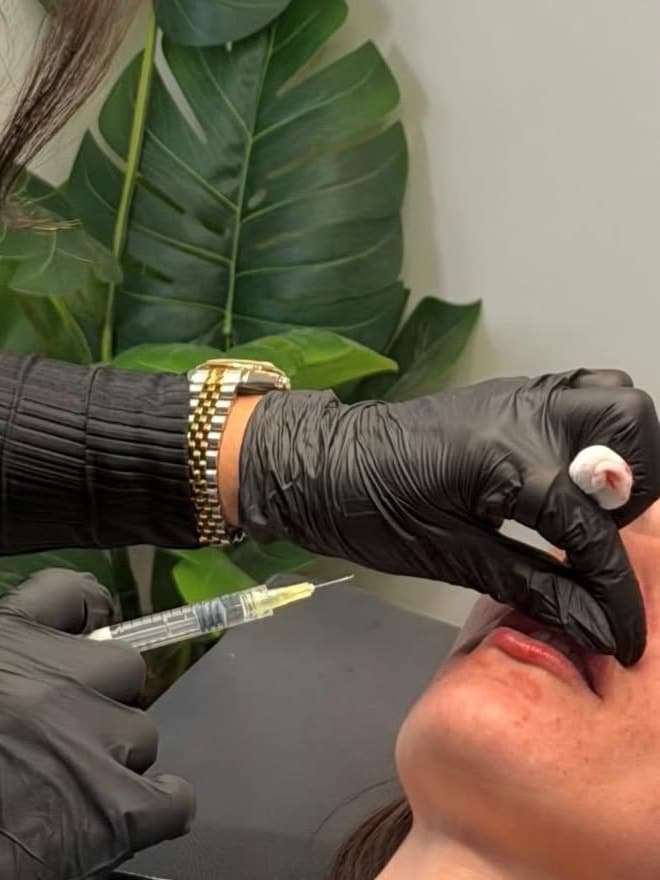
Russian lips are not a product. There is no “Russian filler” in the drawer, and nothing in the syringe differs from the hyaluronic acid used for any other lip filler treatment. What is different is the direction the needle travels — and that single change is what gives the technique its name, its look, and the one honest caveat on this page.
It is a £150 treatment here, and it is the right choice for some mouths and the wrong one for others. Below is what it does, who it suits, and what the research actually says — including the part most Russian lips pages leave out.
Vertical, not horizontal — what actually changes
Classic lip filler is generally placed along the lip in a horizontal vector. Product runs with the length of the lip, and what you tend to gain is projection: lips that come forward and look fuller from the side.
The Russian technique works in a vertical vector instead. Small amounts are placed through the body of the lip in an upward direction, in a series of columns along its length, so the aim is height and definition — a lifted vermilion, a sharper cupid’s bow, a flatter profile from the side than a classic result. It is a needle technique rather than a cannula one; a 2024 comparison of lip injection techniques in Cureus notes in passing that “some popular techniques, such as Russian lips, require needle injections”.
That is the whole mechanism, and it is worth being clear about it, because the word “Russian” gets used in clinics to mean almost anything. If someone quotes you for Russian lips, the fair question is which direction they inject and why they think your lips suit it.
Who it suits
The technique earns its place when the complaint is about shape rather than size. In practice that usually means one of these:
- You want height, not projection. You like your lips from the side but want more of them visible from the front.
- Your cupid’s bow has flattened. Definition at the centre of the upper lip is exactly what a vertical vector is aimed at.
- Your lips are untreated. The £150 price is for virgin lips, or lips previously done with the same technique, and virgin lips are where a vertical build is most predictable.
- You want something reversible. It is hyaluronic acid, so it can be dissolved. That is not true of lip blush, which is pigment rather than gel.
And the honest other side of that list. A very thin upper lip with little vermilion height to work with often does better with a conservative classic placement. Lips with existing filler that has already crept above the border need that dealt with first, not built on. And if what you actually want is colour and a defined edge rather than more lip, our guide to lip blush vs lip filler is the better read before you spend anything.
What to expect
Your appointment, step by step
Consultation and a straight answer
Safina looks at the actual shape of your lips — the height of the vermilion, where your cupid's bow sits, how symmetrical the two sides are, and whether there is old filler in there and where it has travelled. This is where you find out whether the Russian technique suits your mouth, or whether a classic placement would give you a better result for the same money.
Numbing
The lips are numbed before anything else happens, and the filler itself contains local anaesthetic. The Russian technique uses a needle rather than a cannula and involves more entry points than a straightforward refresh, so comfort is worth the extra few minutes.
Vertical placement, built in stages
Filler is placed in small amounts through the body of the lip in an upward vector, worked along the lip rather than deposited all in one spot, and checked in the mirror as the shape builds. Conservative volume here is deliberate rather than timid — the research on vertical techniques is the reason, and you can always add at a review.
Two weeks, then judge it
You will see height straight away, but you will also swell — lips always do, and a 48-minute treatment swells more than a 0.6ml top-up. Expect 24 to 72 hours of noticeable puffiness and the odd bruise. Your real shape is the one you see at about two weeks, which is also when any adjustment should be discussed rather than on day three.
Being straight with you
What the research says about vertical techniques
Most pages selling this treatment stop at the before-and-afters. There are two studies worth knowing about, and neither flatters the technique unreservedly. We would rather you read them here than discover them later.
The important one is a 2026 study in Plastic and Reconstructive Surgery (Harris and colleagues), which used high-frequency ultrasound to look inside the lips of 126 people at clinics in London and Amsterdam — 52 who had been treated with filler and 74 who had not. Two findings matter here. First, the subcutaneous layer of the lip averaged less than a millimetre thick, so filler ended up partly inside the muscle in most treated people regardless of which technique was used or how deep the injector intended to go. Second, and more to the point: filler had spread beyond the intended site in 73% of the vertical-technique lips (22 of 30), against 24% of the horizontal ones(5 of 21). The authors name “tenting” and the “Russian lip” as their examples of vertical techniques, and conclude that vertical vectors produce “greater filler migration, hypervascularity, and glandular changes”, while horizontal techniques are “more predictable and safer”.
Read it carefully, though, because the authors are careful themselves. It is a cross-sectional study, which means it cannot prove that the technique caused what the scans found. The sample is modest. Techniques were grouped together for the analysis, and crucially the technique each person had was classified from patient self-report or from what their clinic advertised — not from a verified record of what was actually done. Individual injector variation, the authors note, may influence the results. So this is strong evidence that something real is going on, not a verdict on every vertical treatment ever performed.
The second study is the Cureus comparison (Buhsem, 2024) — as far as we can tell the only attempt to compare needle directions head to head. It covered 216 women aged 19 to 39, all treated by the same plastic surgeon with the same 0.6ml of filler in the upper lip, split by needle direction. Satisfaction at three weeks came out at 4.78 out of 5 for top-to-bottom placement, 4.15 for lateral-to-medial with a needle, 3.85 for lateral-to-medial with a cannula, and 3.70 for bottom-to-top— the upward direction a Russian treatment uses. No major complications occurred in any group. Its limits are real too: retrospective, a single operator, no objective photographic measurement, and a follow-up of only three weeks, which is barely past the swelling.
Here is what we take from both. Technique matters more than product, and a vertical vector asks more of whoever is holding the needle. That is why this treatment sits behind a consultation rather than being a one-tap add-on: Safina keeps the volume conservative, places it along the lip in stages rather than in a few large deposits, reviews the shape at two weeks, and will tell you plainly if your lips are better served by a classic placement. If a clinic tells you the migration question is a myth, they have not read the scans.
Expectations
The lips you have seen online
Almost everyone who asks for Russian lips has a saved photo. That is fine — it is genuinely useful to see what you are aiming at. It is worth knowing what that feed is made of, though.
A 2025 study in Aesthetic Surgery Journal Open Forum classified 120 before-and-after images from four trending lip-enhancement hashtags and compared them with 214 real clinic patients. Instagram showed a much narrower range of lip types than the clinic did — only ten distinct types before treatment — and after treatment the images converged overwhelmingly on a single shape. The researchers describe it as a standardisation of the beauty ideal, and warn about how it shapes what patients expect.
Practically, that means the photo on your phone was taken on someone whose starting lips were probably not shaped like yours, and quite possibly after more product than you want. The NHS makes the same point more bluntly in its guidance on what to do before a cosmetic procedure: take extra care researching anything you find on social media, because “social media influencers are usually paid to advertise the service”. Bring the photo anyway. Safina will tell you which part of it is achievable on your mouth and which part belongs to someone else’s.
Pricing
Russian lip prices
One price, 48 minutes, and no upsell in the room. The alternatives are listed alongside it on purpose — if a classic placement is the better result for you, it is also the cheaper one.
Lip filler 0.6ml45 min
A subtle first step or refresh
from £115
Signature lips 1.1ml45 min
from £150
Russian lips48 min
Virgin lips or previous Russian technique
£150
Dissolve & refill lips35 min
Dissolve, then refill after 2 weeks with 1.1ml
£240
Dissolving filler30 min
For migration or correction; patch test required
from £120
Prices are correct at the time of publishing and are confirmed at your consultation. Some treatments start from the price shown and vary with the amount of product used or the area treated.
The £150 is for virgin lips, or lips previously treated with the Russian technique. That wording is deliberate. If you have had classic lip filler elsewhere, what is already in your lips changes the plan — sometimes the answer is to work with it, sometimes it is to dissolve and rebuild. Mention it when you enquire and it can be assessed properly rather than discovered on the day.
Budget for this as something you repeat. Lip filler of any kind lasts roughly six to twelve months, and lips break it down faster than a cheek or a jawline because they never stop moving. The NHS advice above also asks you to understand the full cost before you start, aftercare and future top-ups included — which is fair, and the honest figure is the one above every six to twelve months rather than once.
If you are working towards a wedding or a big event, do not book this in the fortnight before it. Our bridal beauty timeline sets out when each treatment should happen, and lip filler wants a clear margin for swelling and any bruising.
Before you book — here or anywhere
Who’s holding the needle
For a technique where the evidence points at the method rather than the material, this is the part that matters most. The NHS guide to choosing who will do your cosmetic procedure sets out what to ask: what training and experience they have, and whether they are insured. It also advises checking for a register accredited by the Professional Standards Authority. The companion page adds that you should be offered a cooling-off period after any consultation, and that you can walk away at any point. Both are reasonable things to expect from anyone, including us.
One hard legal line, because lips are where it gets tested most. Since 1 October 2021 it has been a criminal offence in England to inject cosmetic filler into anyone under 18 for cosmetic purposes — including making the booking — under the Botulinum Toxin and Cosmetic Fillers (Children) Act 2021. Any clinic willing to treat a 17-year-old is breaking the law, and that tells you everything else you need to know about them.
At Lady Young’s the same person does your consultation and your treatment. Safina has sixteen years in the beauty industry, holds a Level 5 Ofqual qualification in aesthetics and is fully insured — there is more on the about page, and what clients say is on the reviews page. If the Russian technique is not right for your lips, you will hear that at the consultation rather than after the swelling goes down.
Your questions
Russian lips FAQs
You might also like
Related treatments & guides
Lip Fillers
The full lip menu — a 0.6ml refresh, signature 1.1ml lips, boosters and dissolve-and-refill.
See all lip optionsGuide: Lip fillers
Whether they hurt, how long they last, swelling and how to get a natural result.
Read the guideGuide: Lip blush vs lip filler
Colour or volume: which one your concern actually needs, before you book either.
Learn moreBook your appointment
Ready when you are
Every treatment starts with an honest, no-pressure consultation. Book online in a few taps, or get in touch with any questions.
Call 07500 503034 · Bracknell, Berkshire