Ear & body piercing
Helix & Cartilage Piercing in Bracknell
Helix, forward helix, flat, conch, tragus, rook and snug — £35 each, in medical-grade titanium, placed around your own ear rather than a template. With the real healing time explained before you book.
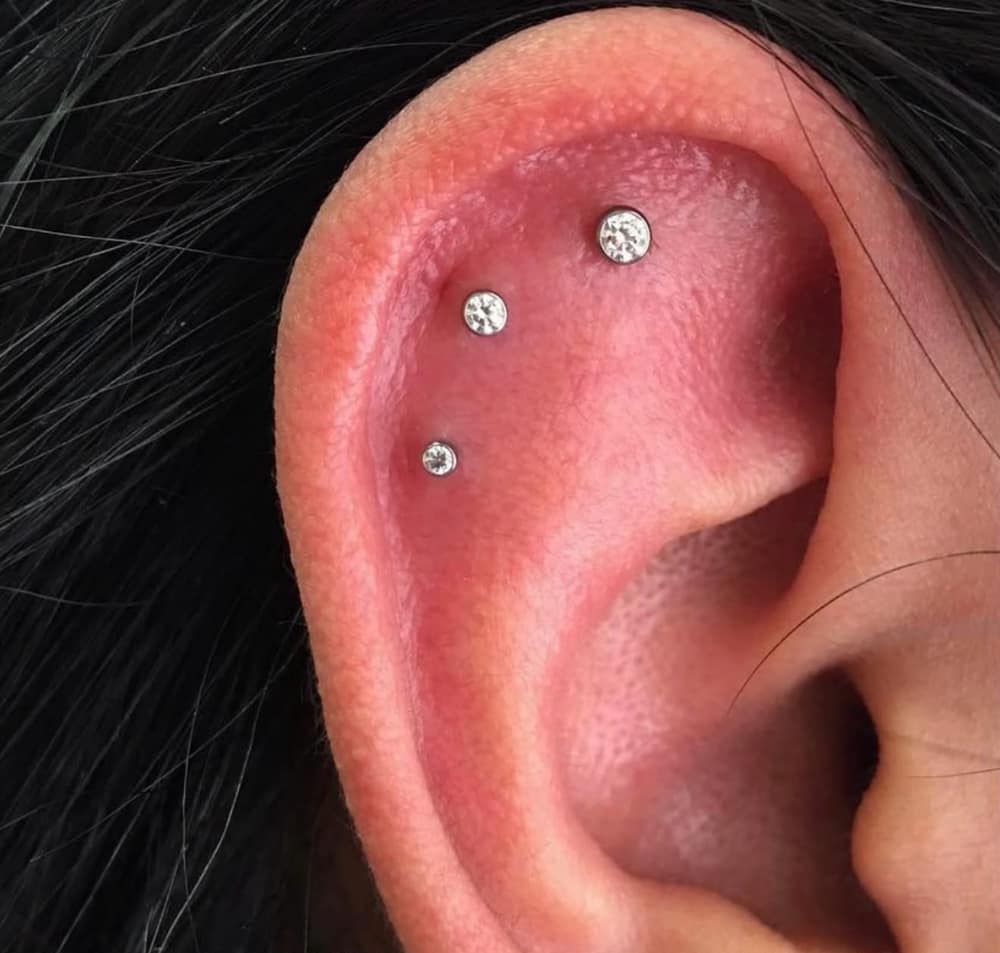
A cartilage piercing is not a lobe piercing higher up the ear. It goes through firm tissue with a comparatively poor blood supply, which changes almost everything that follows — how long it takes to heal, how it behaves if it is knocked, and what happens if it does get infected.
At Lady Young’s, a helix, forward helix, flat, conch, tragus, rook or snug is £35 and includes the medical-grade titanium jewellery. A hidden helix, anti-helix, daith or industrial is £40. Safina does the piercing herself, in a private one-to-one studio in Bracknell, with sterile single-use equipment — the same room and the same standards as everything else on the ear and body piercing menu.
This page spends more words on the next twelve months than on the twenty minutes in the chair, because that is where the difference between a cartilage piercing you love and one you give up on is actually decided.
Which cartilage piercing is which
The names describe places on your ear rather than styles, which is why a photograph someone brings in is a starting point rather than an order:
- Helix— the outer rim of the upper ear. The most forgiving cartilage placement and the usual first one.
- Forward helix— the small ridge at the front of the ear, just above the tragus, where the rim meets the head.
- Flat— the broad flat panel inside the rim. Good for a stacked, curated look because there is room.
- Conch— the shell-shaped bowl in the middle of the ear, done here with a labret stud.
- Tragus— the small flap in front of the ear canal, also a labret stud.
- Rook and snug— the inner folds. Both need a genuine ridge to sit in, both are thicker, and both are slower.
If you want several and are not sure how they should sit together, that is what the bespoke package at £90 is for: three ear piercings with Safina guiding the placement around your anatomy, which is a different conversation from booking three separate appointments and hoping they line up.
What to expect
Your appointment, step by step
Your anatomy decides what is possible
Not every ear can take every piercing, and that is anatomy rather than skill. A rook needs a defined ridge to sit in; a forward helix needs enough depth at the front of the ear; a flat needs a flat. The first part of the appointment is looking at your ear and being honest about which of the placements you have in mind will actually sit well — and which will fight you for a year.
Marked, and checked in a mirror
The spot is marked and you see it before anything happens. If you are planning a curated set over time, say so now — a helix placed without reference to the stack you eventually want is the thing people most often end up having re-done.
A clean, single-use set-up
Every piercing is done with sterile, single-use equipment and sterile medical-grade titanium jewellery. This is the part that matters most and the part worth asking any piercer about, anywhere.
The piercing itself
Quick — the appointment is 15 to 20 minutes and the piercing is a small part of it. The initial bar or labret post is deliberately a little longer than the finished look needs, because the ear will swell and jewellery that is too tight causes its own problems.
Aftercare, and a downsizing plan
You leave knowing how to clean it, what is normal in the first few weeks, what is not, and roughly when to come back to have the post shortened. If something worries you in month three, get in touch rather than guessing — cartilage is the one placement where waiting it out is the wrong instinct.
The bit people underestimate
How long cartilage really takes — and why the guidance disagrees
There is a genuine split here, and it is better to know about it than to be surprised by it. The UK’s national ear and face piercing aftercare leaflet — published by Public Health England’s North West and East Midlands teams with the Tattoo and Piercing Industry Union, and the same guidance we use for a nose piercing — lists ear cartilage at 6 to 8 weeks, exactly the same as an ear lobe.
Clinical sources put it far higher. Cleveland Clinic gives a lobe as around six to eight weeks but says cartilage “may take up to six months or a year to fully heal”, and gives the reason plainly: cartilage does not get as much blood supply as soft tissue, so it does not repair itself quickly.
We are not going to pretend those two figures agree. Plan around the longer one.The leaflet itself says its times are approximate and depend on your health and your aftercare, and the Association of Professional Piercers makes the point that a piercing “may seem healed before the healing process is actually complete” because the wound heals from the outside in — so the interior can still be fragile when the surface looks perfect. Six to eight weeks is roughly when a helix stops hurting. It is not when it is finished.
One practical consequence worth planning for: if you want to wear a particular piece of jewellery at a wedding or an event, a cartilage piercing needs months of notice, not weeks. Our bridal beauty timeline puts new piercings nine to twelve months ahead of the day for exactly this reason.
Please read before booking anywhere
The risk that matters, honestly
Most cartilage piercings are uneventful. The one complication worth understanding in advance is perichondritis— infection of the tissue around the cartilage — because unlike a grumpy lobe it is time-sensitive, and because the usual instinct of waiting a few days to see if it settles is the wrong one.
A 2015 systematic review in The Laryngoscope pooled 29 studies covering 66 patients with infections after cartilage ear piercing. Its findings are worth stating plainly:
- Patients waited an average of 6.1 days before seeking medical attention, and more than five days of symptoms beforehand made hospital admission significantly more likely.
- Pseudomonas aeruginosa accounted for 87.2% of the infections — not the Staphylococcus most people and many first-line prescriptions assume.
- The initial oral antibiotic did not cover the organism actually cultured in 53.3% of cases— and of those, 87.5% ended up hospitalised.
- Lasting ear deformity followed infection of the scapha — the groove inside the rim — in 100% of those cases, against 43% for the helix.
A 2025 review in the same journal looked at 217 patients with auricular perichondritis, of whom 120 had it after a piercing. That group was younger, healthier, more likely to be carrying Pseudomonas and significantly more likely to form an abscess — and abscess formation was by far the strongest predictor of a complicated course. Symptoms started on average 19 days after the piercing, so this is not only a first-week problem.
What to actually do with that.If a cartilage piercing is getting worse rather than better — spreading redness, increasing swelling, throbbing, heat, or discharge with a smell — get seen within a day or two rather than waiting a week. Say out loud that it is a cartilage piercing, because that single fact changes which antibiotic is appropriate. The NHS guidance on infected piercings is to leave the jewellery in unless a doctor tells you otherwise, and to ask for an urgent GP appointment or call 111. None of this is a reason not to have one done. It is a reason to recognise it early.
Lumps
Bumps, granulomas and keloids
Almost every cartilage piercing produces a bump at some point, and almost none of them are infections. The national leaflet is specific about this: cartilage piercings occasionally form lumps commonly known as granulomas, this is just trapped fluid, and it can usually be resolved with heat and pressure from a warm water compress once a day, replacing one of your daily cleanings rather than being added on top of them.
A keloid is a different thing and much less common. The NHS describes a keloid scar as a raised scar that keeps growing beyond the original wound, says it can follow any damage to the skin including a body piercing, and lists the ears among the most common sites. You are more likely to get one if you are aged 10 to 30, if you have had a keloid before, or if you are of South Asian, Chinese, African Caribbean or Black African origin. Treatments exist — steroid injections, silicone dressings, cryotherapy, laser — but surgical removal is usually avoided because the scar tends to grow back larger.
The practical distinction: a granuloma sits right at the piercing, appears fairly early and settles with warm compresses. A lump that keeps growing, spreads past the piercing site or arrives months later deserves a GP’s opinion rather than another fortnight of home treatment. If keloids run in your family, tell us before you book — it is a genuine reason to think carefully about placement.
Aftercare
Looking after a new cartilage piercing
Your full aftercare is given at the appointment. In outline, the UK national leaflet asks for a warm salt-water clean twice a day, preferably after washing or bathing: a quarter of a level teaspoon of (preferably sea) salt to an egg cup or shot glass of warm water, either soaking the ear or holding a clean cloth or gauze against it as a warm compress to soften any crusting. Then:
- Wash your hands first, every time. The leaflet calls hand washing the single most important way of reducing infection, and it is the step people skip.
- Dry with disposable paper towel only — never a shared hand or bath towel, and never cotton wool, whose fibres catch in the piercing.
- Never move the jewellery while it is dry. Hardened discharge turned through the channel tears it, lets bacteria in and sets healing back.
- Check the balls on any barbell.The leaflet’s instruction is to tighten them by screwing to the right while you clean.
- No swimming for the first 24 hours, and no sunbeds for two weeks.
- Mind the hairbrush, the hairdryer and your hairdresser. The leaflet warns that any knock or bang can make swelling and soreness flare up again at any point in healing, and the Association of Professional Piercers specifically suggests telling your stylist about a healing piercing.
- Sleep off it.The same guidance warns that sleeping directly on a healing cartilage piercing causes irritation and can shift the angle of the piercing — a travel pillow with the ear in the opening is the usual trick.
Where the guidance disagrees, and what we suggest. The UK leaflet permits mild antibacterial solutions and soaps on an ear piercing, with the caveat to stop if irritation, redness or drying occurs — unlike nostrils and septums, where it says they are not suitable at all. The Association of Professional Piercers takes a different line: sterile saline wound wash with 0.9% sodium chloride as the only ingredient, no home-made sea-salt mixes (which they say commonly end up far too strong), no beauty or personal care products on or around the piercing, no over-cleaning, and no twisting or rotating the jewellery at all. Both are credible. The safe overlap is the one we recommend: clean gently twice a day, never while dry, keep everything else off it, and if anything you are using stings or dries the skin, stop using it and ask.
Jewellery
Titanium, fit, and downsizing
Every piercing here is done with sterile medical-grade titanium, and the jewellery is included in the price — there is no separate charge for it. The Association of Professional Piercers’ guidance on initial jewellery recommends implant-certified titanium and describes it as well suited to anyone with concerns about nickel sensitivity, which is the most common cause of a reaction to jewellery.
Fit matters as much as material, and in cartilage it matters more. The same guidance warns that jewellery which is too tight restricts circulation and interferes with normal drainage, that jewellery too small risks embedding, and that jewellery too large catches and causes trauma. A cartilage piercing is therefore started on a deliberately longer post to allow for swelling — and then downsized once the swelling has gone, which the APP notes many piercings need before they are fully healed. That is a 15-minute appointment from £10, including the titanium post. If you want a specific piece of jewellery, get in touch before booking so it can be ordered in time and the price confirmed.
Good to know
Registration, age and what to ask
In England, cosmetic piercing is regulated at council level. Under section 15 of the Local Government (Miscellaneous Provisions) Act 1982, both the person carrying out the piercing and the premises they work from must be registered with the local authority. It is a fair question to ask anywhere, including here, and a studio that cannot answer it is telling you something.
On age: there is no national minimum for piercing in England. The Tattooing of Minors Act 1969 sets 18 for tattoos, but it defines a tattoo as the insertion of colouring into the skin and says nothing about piercing, so the under-18 rule people repeat for tattoos does not transfer automatically. Ours is that anyone under 18 needs parental consent, and for the bespoke three-piercing package a parent or guardian must be present.
Every piercing here is carried out by Safina personally, in a private studio, start to finish. There is more about her training and experience on the about page, what clients actually say is on the reviews page, and general questions are answered on the FAQ page.
Pricing
Cartilage piercing prices
Medical-grade titanium jewellery is included in every price below. Under-18s need parental consent, and for the bespoke package a parent or guardian must be present.
Ear rim / helix20 min
Medical-grade titanium jewellery
£35
Forward helix20 min
Medical-grade titanium jewellery
£35
Flat15 min
Medical-grade titanium jewellery
£35
Conch20 min
Medical-grade titanium labret stud
£35
Tragus20 min
Medical-grade titanium labret stud
£35
Rook20 min
Medical-grade titanium jewellery
£35
Snug20 min
Medical-grade titanium jewellery
£35
Hidden helix20 min
£40
Anti-helix15 min
Pierced with a sterile titanium barbell
£40
Daith20 min
Medical-grade titanium hoop
£40
Industrial15 min
Medical-grade titanium jewellery
£40
2 piercings30 min
Anywhere on the ear apart from industrial, or a nose and an ear together
£60
Bespoke piercing package35 min
Three ear piercings, placed and styled to your own anatomy. Under 18s need a parent or guardian present
£90
Jewellery change or downsizing15 min
£10 for a shorter labret post, £15 with a sparkle flat-back stud; titanium jewellery included
from £10
Prices are correct at the time of publishing and are confirmed at your consultation. Some treatments start from the price shown and vary with the amount of product used or the area treated.
Looking at something other than an ear? A nostril piercing is £30 and has its own page, and the full ear and body piercing menu runs from a single lobe at £25 through belly and dermal piercings.
Your questions
Cartilage piercing FAQs
You might also like
Related treatments & guides
Ear & Body Piercing
The full piercing menu — lobes, cartilage, daith, belly, dermals and curated ear styling, all in titanium.
View piercing menuNose Piercing
A single nostril in medical-grade titanium, £30 — with the six-month healing reality explained first.
Learn moreGuide: Bridal beauty timeline
Why a new piercing belongs nine to twelve months before the day, and what to book when.
Read the guideBook your appointment
Ready when you are
Every treatment starts with an honest, no-pressure consultation. Book online in a few taps, or get in touch with any questions.
Call 07500 503034 · Bracknell, Berkshire